
 Trade-in
 Pay in 4
 Free Delivery
Synergistic Research
Synergistic Research Foundation SX IFT Jumpers
Synergistic Research Foundation SX IFT Jumpers
Couldn't load pickup availability
 Pay in 3
 Pay in 3
Share
Details
Description
Disadvantages of The Traditional Bi-Wire Termination
When you bi-wire your loudspeakers, the input of the high and the low pass filters are fed with different input signals. This difference is a result of the high and low frequencies being forced to travel different paths, perhaps through different types of cables, but under all circumstances through cables that have seen different loads. A tweeter with a high pass filter has a completely different impedance response compared to a woofer with a low pass filter!
The drivers do not integrate when their filter halves (crossovers) are fed with unequal signals. The result is the generation of phase error that effects the sound and transfer of phase information to the different drivers in a speaker. This phase error occurs because there will be non-linearity in the low and high-frequency paths.
What does this sound like? Well, usually, just as you would expect from physics, it appears as a change in the reproduction of space and sound staging. The impression after a week or month is that all recordings sound very much alike.
Integrated Frequency Termination (IFT) Bi-Wire
All Synergistic Research speaker wires, from Core UEF through Galileo UEF, function as a “lens” to control electromagnetic inter-modulation with geometries engineered to precisely control electromagnetic fluctuations, for perfect phase and frequency transfer. IFT Bi-Wire ensures that your amplifier “sees” consistent loading, from low to high frequencies, for sound staging that is as expansive as it is precise. Low frequencies are further tuned, in series, with high frequencies, through a transmission line precisely tuned to low-frequency transfer, that exactly match the speaker wire geometry.
Shotgun Bi-Wire vs. IFT Bi-Wire
One option that does not take advantage of IFT Bi-Wire is a “shotgun” termination of two parallel speaker wires, terminated to a common set of spades or bananas at the amplifier end. Obviously, this option would double the cost of bi-wiring your system (when compared to IFT Bi-Wire). but would it carry higher performance? The simple answer is probably not. First, by separating the high(er) frequencies from low frequencies, the amplifier sees very different loads, and transfers your music as a mismatched signal, with significant phase distortion to your speakers. It is as if you are “focusing” on the upper frequencies with a wide-angle lens, and focusing on the low frequencies with a telephoto lens. This presents high frequencies and low frequencies in different aspect ratios, for a soundstage that sounds “bigger” in the upper registers than it does in the lower registers, and this then introduces sound staging problems. A far better option would be to spend the extra money on a higher level speaker wire (with IFT Bi-Wire), thereby elevating your systems presentation in an equal and balanced way.
If the manufacturer of your speakers insists on running separate speaker wires to the high and low frequency of your speaker’s binding posts, we can arrange for you to audition two speaker cables in “shotgun” vs. the equivalent higher end IFT Bi-Wired speaker wire (of approximately the same value). You can make the final call as to which bi-wire option delivers higher performance.
IFT Bi-Wire vs. Jumper Cables
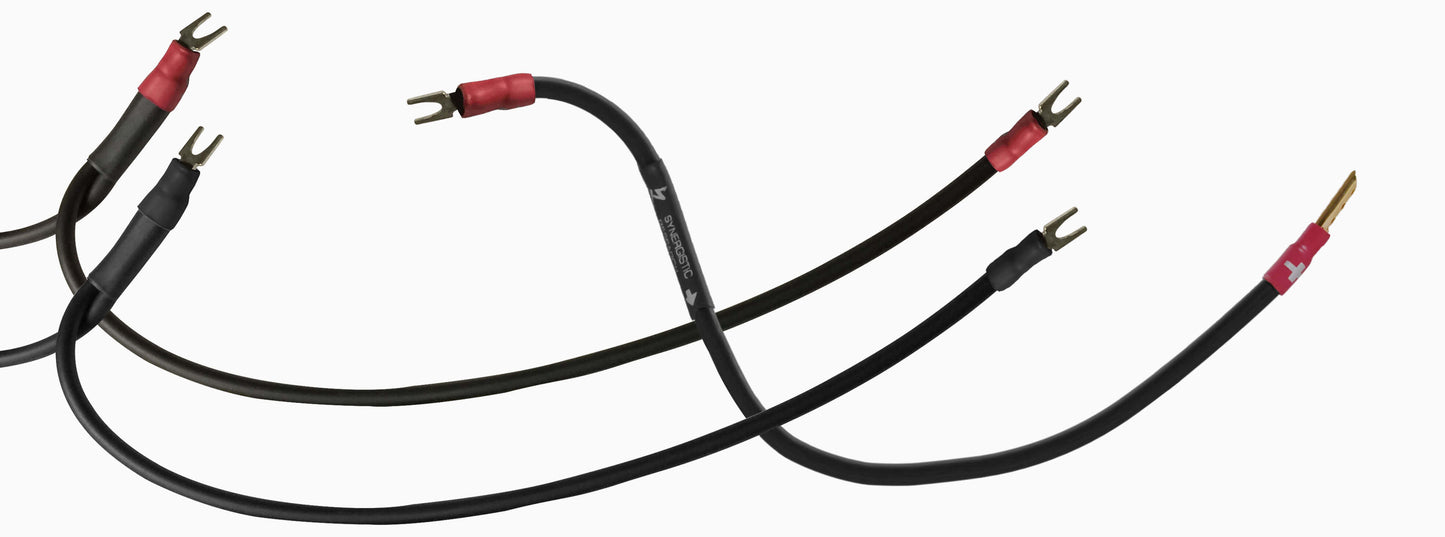
So how is IFT Bi-Wire termination different from standard jumper cables or binding straps? Simple: Jumper cables are rarely tuned to the frequency range they are intended to transfer, and are often times of a much lower quality than the speaker cables they are used with. Furthermore, jumper cables introduce additional hardware, in the form of spade lugs or banana plugs, that further degrade the sound. Bi-wire binding straps are almost always worse then jumper cables, as they are little more than plated metal of a quality and build that introduces considerable distortion in the form of harsh highs or muddy low frequencies.
For the purpose of auditioning Synergistic Research Speaker Cables, many dealers opt for standard non-biwire speaker wire models, and provide you with IFT Bi-Wire Cables to span the connection from your high frequency binding posts to the lower frequency binding posts; identical to the “hardwired” IFT Bi-Wire speaker cables. Aside from the addition of an extra set of connector hardware (spade or banana), the performance will be similar to that of our IFT Speaker Cables.
Specifications
Specifications
Book a Demo
Book a Demo:

Synergistic Research Foundation SX IFT Jumpers
Trade in
Trade in form:
Synergistic Research Foundation SX IFT Jumpers
Price Promise
Price Promise form:
Synergistic Research Foundation SX IFT Jumpers
Bundle deals
Bundle deals
Reviews
Reviews
Delivery & Returns
Delivery & Returns
We offer FREE delivery to the mainland UK (excluding Channel Islands, Isle of Man, Isle of White, Isles of Scilly, and some of the remote Scottish Isles).
For other areas please contact us for a quote. Select items can be delivered internationally by prior agreement. Again please contact us for a quote. We will always do our best to help.
Our aim is to dispatch goods within 2 working days of an order being placed. Please allow 5 working days from the time of your order to receipt of item. If an order is expected to take longer than this our order fulfillment department will contact you to inform you of this.
Where multiple items are ordered, we will dispatch them all in one package. If you have ordered any special or customized items, or items otherwise not immediately available, we will dispatch the order when all items are available. If you have any concerns regarding this, please contact us and we will do are very best to help you.
