
 Trade-in
 Pay in 4
 Free Delivery


MSB Technology
MSB Technology Input Modules
MSB Technology Input Modules
Couldn't load pickup availability
 Pay in 3
 Pay in 3
Share


Details
Description
Input Modules
Interfaces
The input interface can have a significant impact on both the sound quality of the DAC, as well as the overall user experience. Input interfaces are constantly changing and are the main reason why digital equipment becomes obsolete. For this reason, we’ve made our inputs standardized modules that are user replaceable. In each module, we individually design each interface to perform at its absolute peak performance, with minimum noise, jitter, and maximum isolation. While each interface can transfer data to DAC, each has its own advantages and disadvantages. The primary difference between each interface is they add different amounts of noise and jitter to the audio system. With each interface,our goal is to have perfectly isolated, bit-perfect, low noise and low jitter data transfer.
MSB input modules are a standardized, swappable design that supports all of our DACs. This allows any module to be moved from one DAC to another for seemless upgradeability. Each module uses a toolless lever lock system for modules that allows simple, quick upgrades and replacements.
Each interface has advantages and disadvantages. Each interface is covered below:
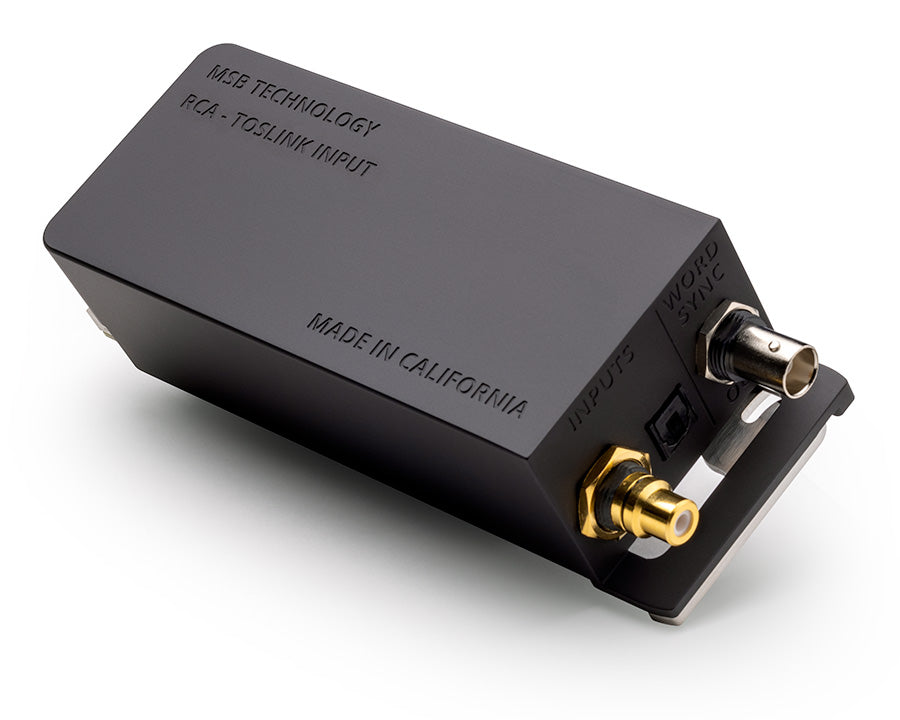
Optical/Coaxial Module (S/Pdif)
This module is our S/PDIF interface modules. Around since the eighties, S/PDIF is the universal interface and is sent over optical, coaxial, or differential cabling. This interface is limited in both sample rate, supported data formats, and bit depth. Toslink, Coaxial, and Balanced digital interfaces are most commonly asynchronous unless a separate clock feedback channel is added to the transport or server. In all of our DACs, we provide the best isolation possible the format allows, helping prevent most electrical noise from coupling from the transport.
Advantages:
-Universal across the industry including consumer market
-Toslink is 100% electrically isolated
-Provides an isolated Word Sync output for clock feedback
Limitations:
-Asynchronous (Unless Word Sync is used )
-Isolation (except for Toslink) is limited
-Medium to High jitter
-No error detection or correction
-Limited to 24/192kHz and 1xDSD via DoP
-Limited to short cable lengths without performance degradation.
Balanced XLR Module (AES/EBU)
This module is our AES/EBU interface module. This interface is limited in both sample rate, supported data formats, and bit depth. Toslink, Coaxial, and Balanced digital interfaces are most commonly asynchronous unless a separate clock feedback channel is added to the transport or server. In all of our DACs, we provide the best isolation possible the format allows, helping prevent most electrical noise from coupling from the transport.
Advantages:
-Universal across the industry including consumer market
-Provides an isolated Word Sync output for clock feedback
Limitations:
-Asynchronous (Unless Word Sync is used )
-Isolation is limited
-Medium to High jitter
-No error detection or correction
-Limited to 24/192kHz and 1xDSD via DoP
-Limited to short cable lengths without performance degradation.
MSB USB Inputs (Not including The Pro USB solution)
Standard USB inputs on DACs are common. What isn’t common is what we do with ours. The entire USB module has a high level of isolation between the USB hardware and the DAC. The USB interface is limited to 384kHz and 4xDSD. Our MQA version also supports full MQA decoding.
Advantages:
-Synchronous to the DAC
-Works with most music server and computer systems that support USB audio
-Works at rates up to 24/768kHz* and 8xDSD*
*Version 2 USB
Limitations:
-Limited level of isolation between the DAC and the often extremely noisy source
-Offers no software control of the DAC from the host source (Volume, etc…)
-Limited to short cable lengths
The MSB Network Renderer V2
There are many renderer interfaces in the industry. We designed and developed our own processing card and software with performance and low noise in mind. Our Renderer V2 interface is MQA and Roon Ready and has a maximum sample rate of 32/768kHz and 4xDSD. The entire renderer solution is galvanically isolated from the DAC, including isolated power. The main advantage of the Renderer Input module is that it turns the DAC into a network endpoint for many current playback software packages and allows computer control of the DAC volume.
Advantages:
-Synchronous to the DAC
-Offers software control of the DAC from the host source (Volume, etc…)
-Works at rates up to 32/768kHz and 4xDSD
-MQA decoding
-Roon endpoint
-Lower noise than most music servers or direct USB connections
Limitations:
-Limited level of isolation between the DAC and the often extremely noisy source
-Offers no software control of the DAC from the host source (Volume, etc…)
-Limited to short cable lengths
MSB Dual Pro I2S Input
This is our earlier priority interface. We offer this input for legacy products. This interface uses a completely proprietary electrical interface and has no resemblance to common I2S on the cabling. It provides clock feedback and a medium level of isolation between source and DAC.
Advantages:
-Synchronous to the DAC
-Some level of isolation between the DAC and the source
-Low Jitter
Limitations:
-Only a medium level of isolation between the DAC and the source
-Offers no control of the DAC from the host source (Volume, etc…)
-No error detection or correction
Universal I2S Input
This is the best interface to transfer both DSD and PCM from third party products (such as the PS audio SACD transports) over an HDMI I2S interface. Unlike the majority of other I2S interfaces it includes a galvanic isolation barrier and software configuration. The Universal I2S input is a powerful toolbox of software configurable blocks. These can be configured to accept nearly any I2S implementation and use it to its fullest potential. Each currently supported transport or server will be listed as a menu option in the DAC or Digital Director’s menu with the most current additions here on our website.
Advantages:
-Enables PCM and DSD from third party transports and servers that support HDMI I2S
-Provides an isolated Word Sync for clock feedback
-Provides the best isolation available in any HDMI I2S interface
-Sample Rates to DSD 8X and 768Khz PCM (depending on source)
-New configurations can be added with software updates
Limitations:
-Limited isolation compared to Pro ISL fiber connection
-No error detection or correction
-Shorter cable lengths
-Asynchronous (Unless source supports Word Sync)
-Only 3.3V signaling and LVDS data channels are supported
Specifications
Specifications
Book a Demo
Book a Demo:

MSB Technology Input Modules
Trade in
Trade in form:
MSB Technology Input Modules
Price Promise
Price Promise form:
MSB Technology Input Modules
Bundle deals
Bundle deals
Reviews
Reviews
Delivery & Returns
Delivery & Returns
We offer FREE delivery to the mainland UK (excluding Channel Islands, Isle of Man, Isle of White, Isles of Scilly, and some of the remote Scottish Isles).
For other areas please contact us for a quote. Select items can be delivered internationally by prior agreement. Again please contact us for a quote. We will always do our best to help.
Our aim is to dispatch goods within 2 working days of an order being placed. Please allow 5 working days from the time of your order to receipt of item. If an order is expected to take longer than this our order fulfillment department will contact you to inform you of this.
Where multiple items are ordered, we will dispatch them all in one package. If you have ordered any special or customized items, or items otherwise not immediately available, we will dispatch the order when all items are available. If you have any concerns regarding this, please contact us and we will do are very best to help you.
